
The second issue with Philosophy Mondays that Claude identified was an insufficiently strong analysis about the relationship between is and ought. I wrote that
Longevity matters not because persistence is inherently good, but because it is the precondition for the knowledge project that gives our existence meaning and our morality its objective foundation.
Claude observes that my reasoning here appears circular. I start with knowledge, then observe that certain moral practices ensure longevity, but conclude that this longevity is not valuable in and of itself but rather because it is allowing the knowledge project to unfold. Claude wrote “The absorbing-states argument shows which moralities survive, you concede that longevity is not goodness, and then hand the justification back to knowledge.”
The second post in the is-ought subseries, makes a variant of the same argument, this time in terms of accumulating resources. The third post then argues for the need to sustain a critical process, so that longevity and resources actually contribute to an improvement in knowledge. Both of these also appear to suffer from the circularity identified by Claude.
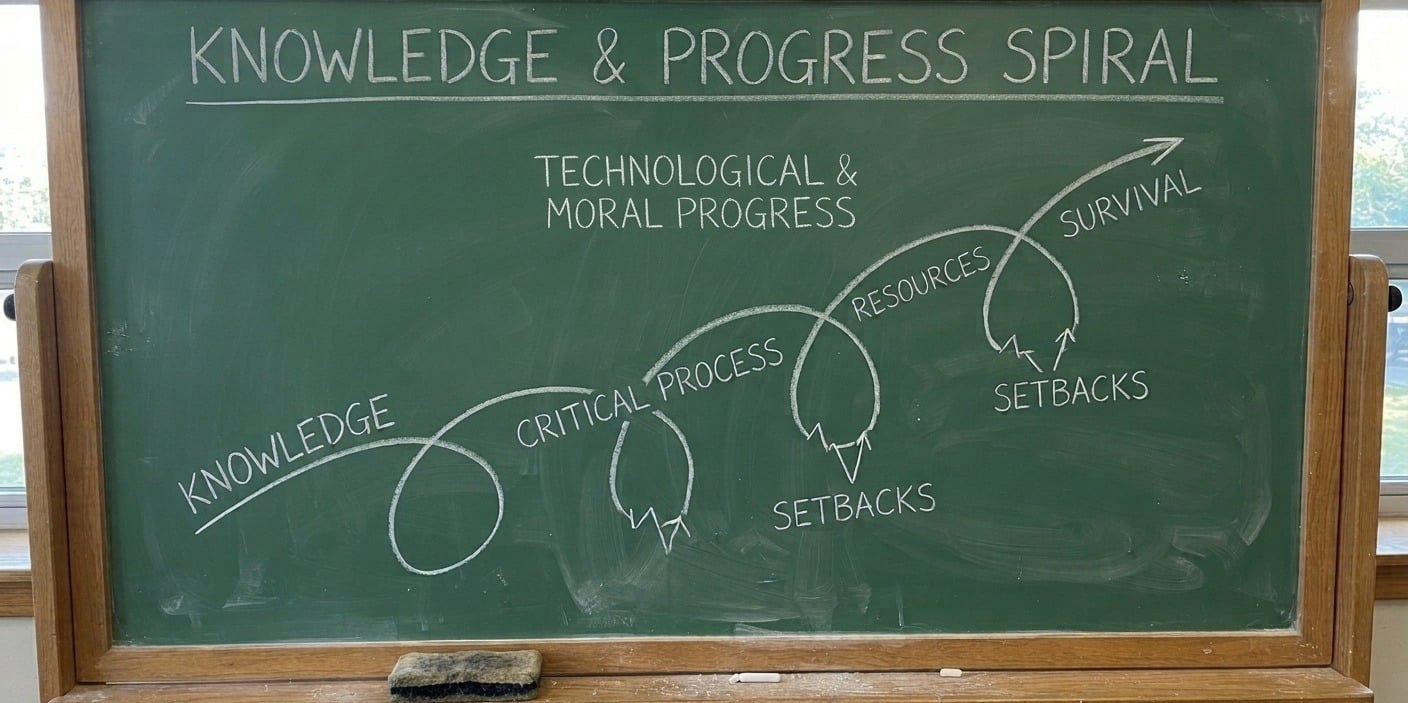
But I am not afraid of circularity. Instead I embrace the feedback loop that exists between knowledge and the unfolding of the world. What I am arguing for is that there is the potential for an upward spiral of progress. We can see this clearly for the case of technology. Civilizations that cease to exist (such as the Easter Islanders) cannot further their technology. Similarly if a civilization runs out of resources (such as the declining Roman Empire) it can no longer advance its technology. And the same is true for civilizations that suppress the critical process (as was the case for much of the Middle Ages).
The key point now is this: the exact same reasoning applies to moral progress. Moral progress also arises from the improvement of knowledge over time with sufficient resources and through a critical process.
Where else could moral progress come from? The most common other source is external to humanity in the form of a god or gods. This has been a core religious claim: access to a moral truth from an external source. Such external source claims, however, are deeply fraught. Their source itself is incompatible with what we have understood from science. Religions also have a long history of dividing humanity, reducing resources, and suppressing the critical process. To be clear, this doesn’t mean that religious traditions cannot contribute to moral progress. They can and have. But they often come with severe side effects.
I have defined technological progress as reducing the tradeoffs between different values when deciding on an action. What then is the nature of moral progress? Linking up to last week’s post, moral progress is more autonomy for more conscious beings. The combination between technological and moral progress is crucial because it means that more autonomy for some isn’t obtained via reduced autonomy for others.
So I appreciate Claude pointing out circularity because it is forcing me to make the argument more explicit. Knowledge enables technological and moral progress. For this progress to continue, morality needs to ensure survival, resources and the critical process. It is a feedback loop that over time reduces tradeoffs between values and increases autonomy for more conscious beings.
Also the image of a spiral isn’t quite right. Major setbacks have occurred in the past and will occur again in the future. At this very moment we are going through a phase of exponential technological progress, especially in AI, combined with substantial moral regress. The latter is largely a reaction to the fears caused by the former. Fear is a poor guide in life and easily exploited by populist leaders. We urgently need positive visions for an age that combines technological progress with human thriving. This is the goal of the work on the Universal Moral Core, along with the ideas in The World After Capital, and the practical initiatives Gigi and I are undertaking with Eutopia.