
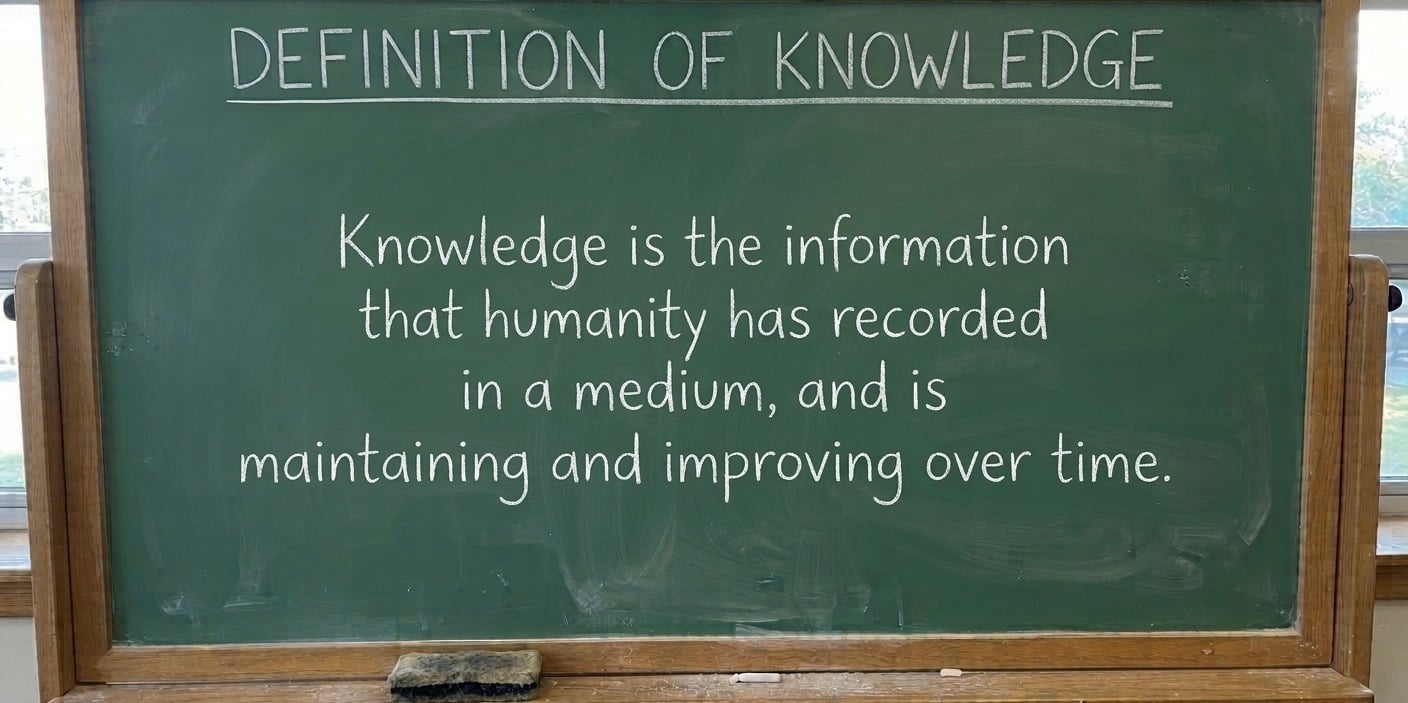
So far in my second turn on Philosophy Mondays I have clarified the relationship between knowledge and consciousness and tightened the argument for how knowledge lies at the heart of technological and moral progress. Given the centrality of knowledge to both of these it is worthwhile revisiting my construction. I define knowledge as the information that humanity has recorded in a medium, maintained and improved over time.
Claude takes two issues with my approach. First, that the definition excludes large areas traditionally considered to be part of knowledge, including tacit know-how, embodied skill and oral traditions. Second, that the definition implies that the morality of an act such as lying might depend on whether it is recorded or not.
I am glad that Claude raised these as potential issues, because I believe they both point to the strength of my approach. Yes. I absolutely am drawing a tighter boundary on purpose. Tighter boundaries make for stronger arguments. Much of what can be said about knowledge by my definition does not in fact apply to tacit know-how, embodied skill or oral traditions. In particular, these cannot be transmitted across space or time separate from a human carrier. They all require human-to-human contact for transmission. This not only makes it much harder for them to attain reach but also makes error correction difficult, as there is no original to go back to. The entertaining game of telephone relies on this difficulty of verification in oral transmission and would not work at all if one were passing along a note!
The initial explosion of human knowledge does not arrive until we start writing information down, especially once we invent moveable type and the printing press. We are now living through a second explosion because we have machines that have ingested all of our externalized knowledge, enabling them to make new connections that have eluded humans. If anything, humans had become ever more specialized over the last hundred years or so, as we accumulated so much knowledge in each little area that becoming an expert required years of studying. This increased specialization reduced humans’ ability to create new knowledge by combining ideas across fields – even within the same discipline, let alone across disciplines. The recent proof of the Riemann hypothesis (which is still being evaluated for errors) draws on ideas from other areas of mathematics that many mathematicians had previously considered irrelevant for this problem. A human mathematician working with a machine was able to make these new connections. The combinatorial scope of humanity’s already existing knowledge is unfathomably large, which is why we are likely to see extraordinary progress as the machines become better at evaluating new combinations. All of this would be utterly impossible for tacit know-how, embodied skill or oral traditions. Also now that the proof exists as a recorded artifact, people and machines all around the world can set about verifying and improving it.
What about the second objection, that my definition implies that technology changes the morality of an act? Yes. That too seems a feature and not a bug of the definition. A lie in a secret diary or in a personal conversation is essentially irrelevant to knowledge. But a lie spread forcefully by recording it and sharing it via social media, does pollute knowledge. Dictators and authoritarians have availed themselves of the most potent available technology to spread misinformation. Flooding the environment disrupts the critical process because it takes longer to correct misinformation than it does to spread it. With generative AI we now face the added difficulty that lies can be fabricated not just in speech and text, but also in images and video. Here too technology changes the morality of an act. Accusing someone of an action they didn’t take is bad (in most cases), but producing a video purporting to show this action is worse. The fake video will potentially remain in circulation impugning the character of its target with minimal recourse for them.
So I am coming away from these challenges feeling even better than before about my definition of knowledge. I realize it is a tall order to try and supersede the existing definitions, but the beauty here is that now that the definition itself is part of knowledge, the critical process can get to work and who knows where that will wind up eventually.